Member-Owned. But Member-Understood?

Credit Union Research Trends for 2027: Understanding the Members You Have — and the Ones You Want
Credit unions have something many financial institutions work hard to build: a reputation for personal relationships, community involvement and putting members first.
But here’s the million-dollar question:
Do prospective members actually understand what makes your credit union different?
And perhaps more importantly, does your current member experience deliver on that promise?
As digital-first competitors reshape financial expectations and younger generations establish new banking relationships, credit unions face a familiar challenge with some very new twists.
Here are five research trends credit unions should be paying attention to as they plan for 2027.
1. Next-Generation Membership: Where Are Your Future Members?
Credit unions have long recognized the importance of attracting younger members. But the challenge isn’t going away.
According to Filene Research Institute, fewer than 20% of Americans under age 40 use a credit union, and the average credit union member is in their mid-50s.
That’s a pretty compelling reason to start asking better questions.
Questions credit unions should be asking:
- Do younger consumers know what a credit union is?
- Do they understand they’re eligible to join?
- What would motivate them to switch financial institutions?
- Which products and benefits resonate with Gen Z and Millennials?
- Where are younger consumers getting financial information?
How RMS helps: Prospect surveys, generational research, focus groups, brand awareness studies and segmentation uncover the perceptions, motivations and barriers shaping membership decisions.
The opportunity: Identify the audiences most receptive to membership, understand what motivates them and refine outreach around the benefits they actually value.
2. Member Retention: Loyalty Isn’t Something You Can Take for Granted
Credit unions are growing nationally, but that growth isn’t evenly distributed.
According to the National Credit Union Administration, approximately 56% of federally insured credit unions had fewer members in the second quarter of 2026 than a year earlier.
That raises an important question: Are you measuring membership, or understanding member relationships?
Questions credit unions should be asking:
- Why do members stay?
- Why are some leaving?
- Are we their primary financial institution?
- Which experiences influence satisfaction and loyalty?
- What would encourage members to strengthen their relationships?
How RMS helps: Member satisfaction surveys, relationship tracking, closed-account research and qualitative interviews help identify the factors associated with retention and attrition.
The opportunity: Understand which member segments need attention, prioritize relationship-building efforts and track changes in member experience over time.
3. Digital Experience: Personal Service Is Great. So Is a Mobile App That Works.
Credit unions have traditionally differentiated themselves through personal relationships.
But today’s members aren’t necessarily choosing between personal service and digital convenience.
They increasingly expect both.
Questions credit unions should be asking:
- Which digital capabilities matter most?
- Where are members experiencing frustration?
- Why aren’t certain products or services being adopted?
- When do members prefer self-service?
- Where does personal interaction still make the biggest difference?
How RMS helps: Digital experience surveys, product research, concept testing, focus groups and member journey research help credit unions understand where expectations and experiences align, or where they don’t.
The opportunity: Prioritize digital improvements that matter to members while preserving the human connections that distinguish the credit union experience.
4. Brand Awareness: Member-Owned Doesn’t Automatically Mean Member-Understood
Credit unions often have compelling stories to tell: community involvement, cooperative ownership, personalized service and financial well-being.
But are those messages reaching prospective members?
And do they influence where people choose to manage their money?
Questions credit unions should be asking:
- How well known are we in our community?
- Do consumers understand the credit union difference?
- Which benefits influence membership consideration?
- How do we compare with banks and digital-first competitors?
- What perceptions might be limiting our growth?
How RMS helps: Image and awareness studies, competitive research, prospect surveys and focus groups uncover how consumers perceive credit unions and what motivates consideration.
The opportunity: Strengthen brand positioning, clarify the membership value proposition and create marketing messages grounded in what prospective members actually care about.
5. Financial Needs: Are You Offering What Members Actually Need?
Member needs evolve. Financial priorities change. And a product that appeals to one generation may be irrelevant to another.
Understanding those differences can help credit unions identify opportunities to deliver greater value.
Questions credit unions should be asking:
- Which financial needs are going unmet?
- What products or services would members find valuable?
- How do needs differ by age, life stage or financial circumstances?
- What financial guidance do members want?
- Which communities offer opportunities for membership growth?
How RMS helps: Needs assessments, member segmentation, product research, market opportunity studies and qualitative research reveal where needs and opportunities intersect.
The opportunity: Inform product development, improve member communications and identify opportunities to serve existing and prospective members more effectively.
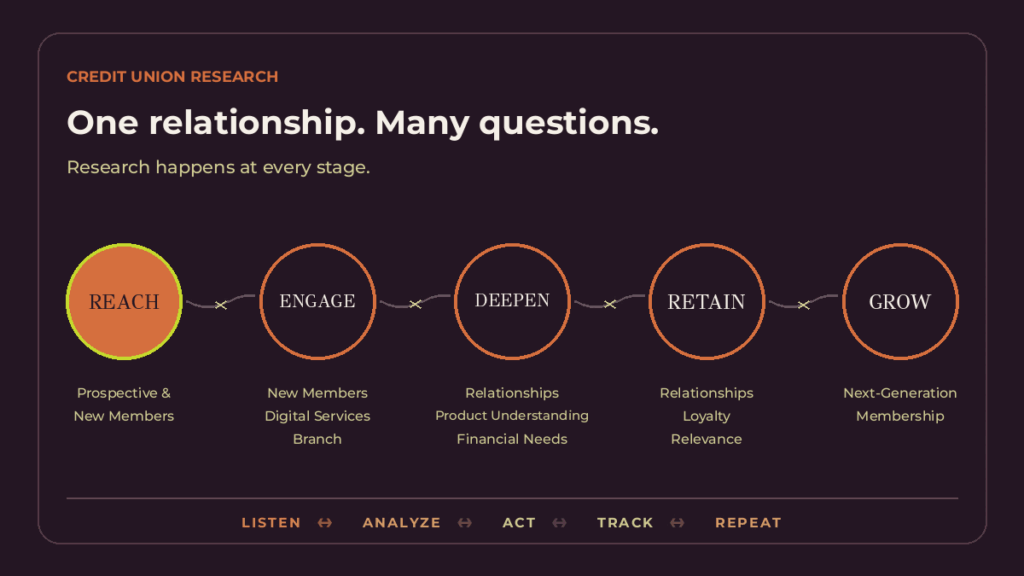
The Next Generation of Credit Union Growth Starts With Better Questions
Attracting members is important. Keeping them engaged, understanding their needs and remaining relevant throughout their financial lives is where the real work happens.
And that takes more than an occasional satisfaction survey.
At Research & Marketing Strategies, we help credit unions connect research across the entire member journey — from prospective members and first impressions to ongoing relationships, loyalty and growth.
Our philosophy is simple:
LISTEN ↔ ANALYZE ↔ ACT ↔ TRACK ↔ REPEAT
Through member surveys, brand awareness studies, qualitative research, mystery shopping, market research and data analytics, RMS helps credit unions turn member feedback into meaningful business intelligence.
Because being member-owned is a powerful distinction.
Being member-understood? That’s a competitive advantage.
Ready to understand what your members, and future members, really want?
Explore RMS’s credit union research capabilities or connect with our team to discuss your next research initiative.
Explore Credit Union Market Research →
Talk With an RMS Research Expert
Learn More
Interested in getting a conversation started? Have a project in mind? Questions looking to be answered? Get in touch and we'll do the same.
Sources: Filene Research Institute, Attracting and Engaging Younger Members and The Next Generation of Member Growth; National Credit Union Administration, Second Quarter 2026 Quarterly U.S. Map Review.