K-12 Education Satisfaction Hits a 27-Year Low: What School Districts Should Do With Their Data
K-12 Education Trends for 2026-27: Turning Parent Feedback Into Action
A new national measure of confidence in K-12 education has reached a historic low.
According to September 2026 research from Gallup and the Walton Family Foundation, just 32% of Americans say they are satisfied with the quality of K-12 education in the United States — an 11-point decline in two years and the lowest level recorded in Gallup’s 27-year trend. Meanwhile, 67% say they are dissatisfied.
But buried underneath that headline is an important distinction for school district leaders: Parents tend to feel much better about the schools their own children attend. Gallup found that 66% of K-12 parents are satisfied with their child’s education, roughly twice the national satisfaction rate. Still, that figure is also a record low among K-12 parents in Gallup’s trend.
That disconnect raises an important question:
What shapes community confidence in a school district, and what can district leaders actually do about it?
For many districts, the answer may begin with something they already have: data.
The Problem Isn’t Always Collecting Feedback. It’s What Happens Next.
School districts conduct parent surveys, student surveys, staff surveys, school climate studies, strategic planning research and community engagement initiatives for good reason.
But conducting research is only the beginning.
Too often, districts collect hundreds or thousands of responses, review a final report or presentation, identify several interesting findings…and move on to the next immediate challenge.
The data sits in a report.
Families who participated may never know what happened because of their input. Staff may not see how their feedback influenced a decision. And when another survey arrives six or 12 months later, stakeholders can reasonably wonder: Did the last one actually matter?
Research published by Alchemer in its 2026 K-12 Parent Trust Report illustrates this gap. In its national survey of 474 parents and guardians, 31.1% said their school asks for feedback but rarely acts on it. Only 52.2% said they had been clearly told how their feedback influenced a decision. Another 26.6% received only a vague explanation, while 17.5% said they were never told.
In other words, collecting feedback isn’t the same thing as creating engagement.
From “We Surveyed Our Community” to “Here’s What We Learned, and What We’re Doing”
The next evolution of K-12 research isn’t simply another annual survey. It’s a closed-loop research process:
Ask → Listen → Analyze → Prioritize → Act → Communicate → Measure Again
That final communication step is particularly important.
If a district asks families about transportation, for example, the process shouldn’t end when the survey closes. District leaders can communicate:
- What the community told them
- Which concerns appeared most frequently
- Where different stakeholder groups agreed or disagreed
- Which recommendations could realistically be implemented
- Which suggestions could not be implemented, and why
- What changes the district decided to make
- When the district will measure the issue again
Not every community recommendation can or should become policy. But stakeholders can still see that their input entered the decision-making process.
That distinction matters.
What K-12 Research Is Telling Us Heading Into 2026-27
The need for better stakeholder research is likely to become more, not less, important as districts navigate several overlapping challenges.
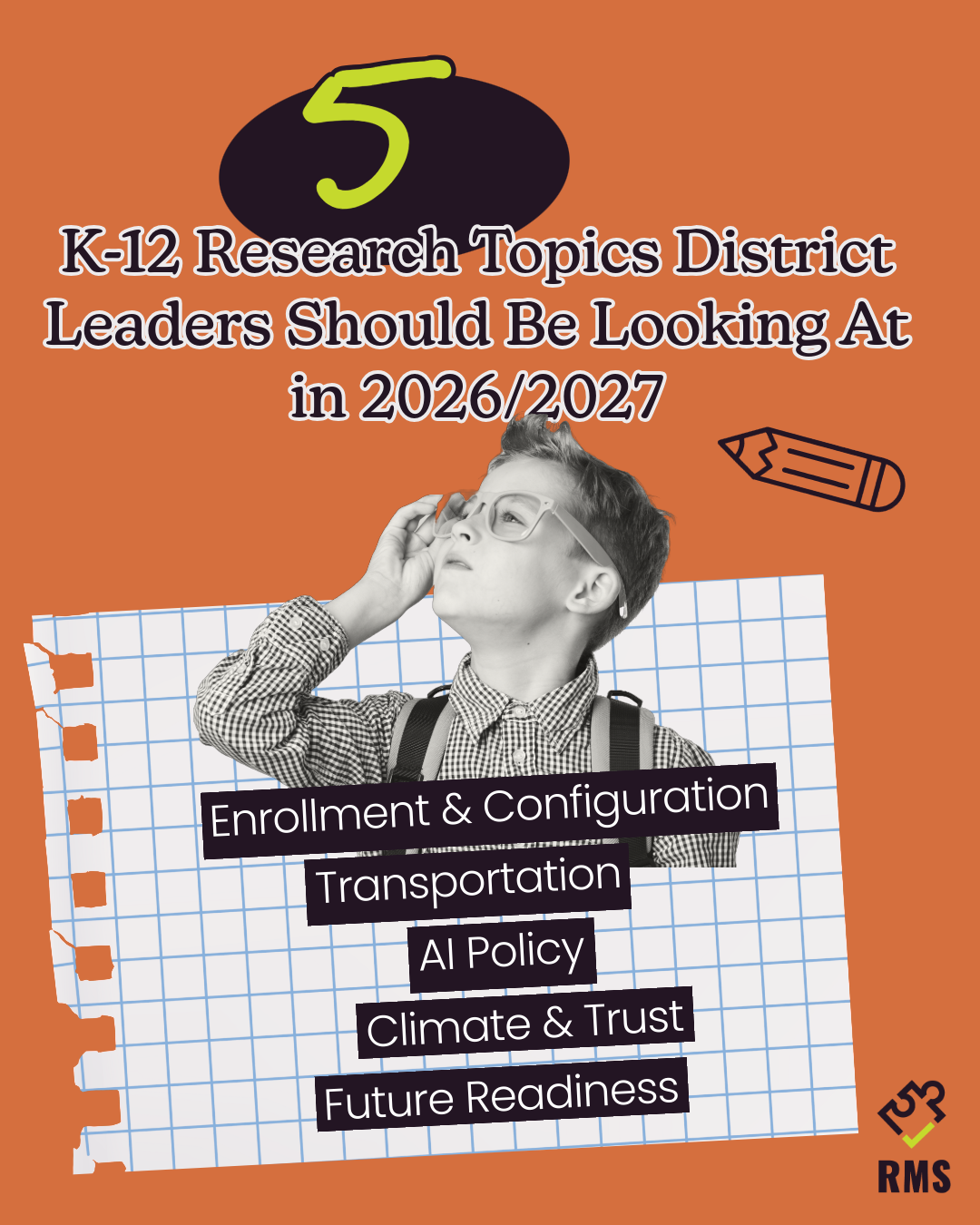
1. Enrollment Decline, Consolidation and Grade Reconfiguration
Enrollment isn’t simply an administrative number anymore. For many districts, it is becoming a strategic planning issue.
The National Center for Education Statistics projects total U.S. public elementary and secondary enrollment to decline approximately 5% between fall 2022 and fall 2031, with enrollment projected to be lower across 40 states and Washington D.C. The Northeast faces an even steeper projected decline.
That can lead districts to consider difficult questions involving building utilization, grade configuration, staffing, attendance boundaries, programming and, in some communities, school consolidation.
These decisions are rarely just operational.
Closing a building can affect neighborhood identity. Moving a grade can change family schedules. Consolidation can raise concerns about transportation, class sizes, extracurricular opportunities and community connection.
Research opportunity: Before decisions are finalized, districts can use community surveys, focus groups, stakeholder interviews and demographic research to understand priorities, concerns and tradeoffs.
The goal isn’t to ask the community to make the decision. It’s to give leadership better information for making it.
2. Transportation Impact & Preference Studies
Transportation changes can look straightforward on a spreadsheet, yet dramatically different around a family’s breakfast table.
Driver availability, route efficiency, enrollment patterns and budget constraints can force districts to reconsider start times, bus routes, transportation zones and school schedules.
A proposed schedule change may affect childcare, parent work schedules, athletics, after-school activities, student sleep and morning routines.
That’s why transportation research should happen before implementation whenever possible, not simply after frustration emerges.
Districts can measure:
Awareness → Preferences → Household Impact → Acceptable Tradeoffs → Communication Needs
When families understand why a change is being considered, and have an opportunity to provide input before the decision is complete, the conversation changes, and families also feel seen and heard, with the ability to rearrange critical timeframes and schedules accordingly.
3. AI Policy Stakeholder Research
Artificial intelligence is rapidly becoming a district policy question involving far more than classroom technology.
Districts are navigating questions surrounding acceptable student use, teacher use, academic integrity, privacy, assessment, equity, professional development and what AI literacy should look like at different grade levels.
That makes AI policy an ideal candidate for stakeholder research.
Rather than developing policy in isolation, districts can measure how teachers, students and parents currently use and understand AI; where concerns differ among groups; what uses stakeholders consider appropriate; and where additional education or guidance is needed. (Read how we recently surveyed nearly 1,000 participants from the RMS ViewPoint panel regarding what our recent survey participants disclosed regarding their knowledge, use and forecast of AI here).
Research opportunity: AI readiness surveys, teacher and staff research, parent perception surveys, student research and stakeholder focus groups can establish a baseline before policies are implemented—and track how perceptions change afterward.
Deeper Dive: RMS recently surveyed its ViewPoint research panel to learn about consumers’ familiarity, opinions and use of artificial intelligence. View the AI survey results and article here.
4. School Climate, Trust & Community Perception
Climate surveys have long measured whether students, parents and staff feel safe, supported and connected.
The emerging opportunity is to connect those measures more directly to trust and responsiveness.
- Does the community believe leadership communicates transparently?
- Do parents understand why major decisions are made?
- Do staff believe their feedback is considered?
- Do students feel they have a meaningful voice?
- Do stakeholders know what happened after the district asked for their input?
Those questions help districts move beyond measuring satisfaction, toward understanding why confidence is rising or falling.
5. Preparing Students for What Comes Next
The latest Gallup research points toward another potential perception gap.
Fewer than three in 10 Americans gave U.S. K-12 schools positive ratings for preparing students to think critically (29%) or preparing students for the world of work (27%).
For districts, this creates an opportunity to understand what “future-ready” actually means to their own community.
Parents, students, educators and local employers may have very different expectations regarding career readiness, college preparation, financial literacy, communication skills, technology, AI literacy, critical thinking and work-based learning.
Research opportunity: Graduate-profile research, employer surveys, student perception studies, alumni research and community surveys can help districts align programming with the skills their communities believe students will need.
6. Technology, Screen Time & Digital Learning
Technology is entering another phase in K-12 education.
The question is no longer simply whether classrooms should use technology. Increasingly, districts must determine when technology improves learning and when it may interfere with it.
Gallup reported in September 2026 that six in 10 teachers would prefer students spend less classroom time using learning devices, while teachers with greater control over how devices are used tend to view classroom technology more positively.
That creates another valuable research question for districts:
What is the right technology balance for our students, teachers and families?
Teacher surveys, parent research and student focus groups can help districts understand where technology is working, where frustration exists and how expectations differ across grade levels.
Don’t Just Track Satisfaction. Find the “Why.”
A districtwide satisfaction score can be useful. But by itself, it rarely tells leadership what to do next.
Imagine a district learns that 68% of parents are satisfied.
Is that good?
Maybe.
But the more actionable questions are:
Which 68%? Why are they satisfied? Why aren’t the other 32%? Has the number changed? Which experiences predict satisfaction? Are perceptions different by school, grade level or stakeholder group? What issue, if addressed, would have the greatest effect on confidence?
This is where trend analysis becomes considerably more valuable than a one-time survey.
When districts consistently measure the same key indicators, they can identify movement over time, compare stakeholder groups and distinguish an isolated concern from an emerging pattern.
Instead of asking only:
“What did our survey say?”
Leadership can begin asking:
“What’s changing, and what should we do next?”
The Research Report Should Be the Beginning, Not the End
The national K-12 satisfaction numbers are concerning. But national sentiment doesn’t automatically describe what is happening inside an individual district.
That’s precisely why local research matters.
Your community may trust its schools.
Parents may strongly support teachers, but feel disconnected from district decision-making.
Staff may support a proposed initiative while worrying about implementation.
Families may accept a difficult transportation or consolidation decision once they understand the alternatives.
You won’t know from national headlines alone.
You have to ask.
And then you have to do something with the answer.
At Research & Marketing Strategies (RMS), we help school districts move beyond simply collecting survey responses. Our education research can help districts identify stakeholder priorities, analyze differences among audiences, track perceptions over time and translate findings into actionable recommendations.
Most importantly, the process shouldn’t stop when the final report is delivered.
The strongest research creates a feedback loop in which leadership can say:
Here’s what we asked. Here’s what you told us. Here’s what we learned. And here’s what we’re doing next.
For districts navigating transportation changes, enrollment decline, school climate concerns, AI policy, strategic planning or other major decisions throughout the next school year and beyond, that may be one of the most valuable ways to build community confidence.
Does your district have survey data sitting in a report, policies coming down the pipeline that need attention now, a major decision approaching that needs community input? Talk with RMS about turning stakeholder research into an actionable plan.
Have a Question? Contact Us.
Sources: Gallup’s September 2026 K-12 satisfaction report, Alchemer’s 2026 K-12 Parent Trust Report, NCES public-school enrollment projections.